

Lighthearted Classics
Oct. 6, 4pm Larksfield Place Independent Living Auditorium
Oct. 8, 1:30pm Central Community Chapel
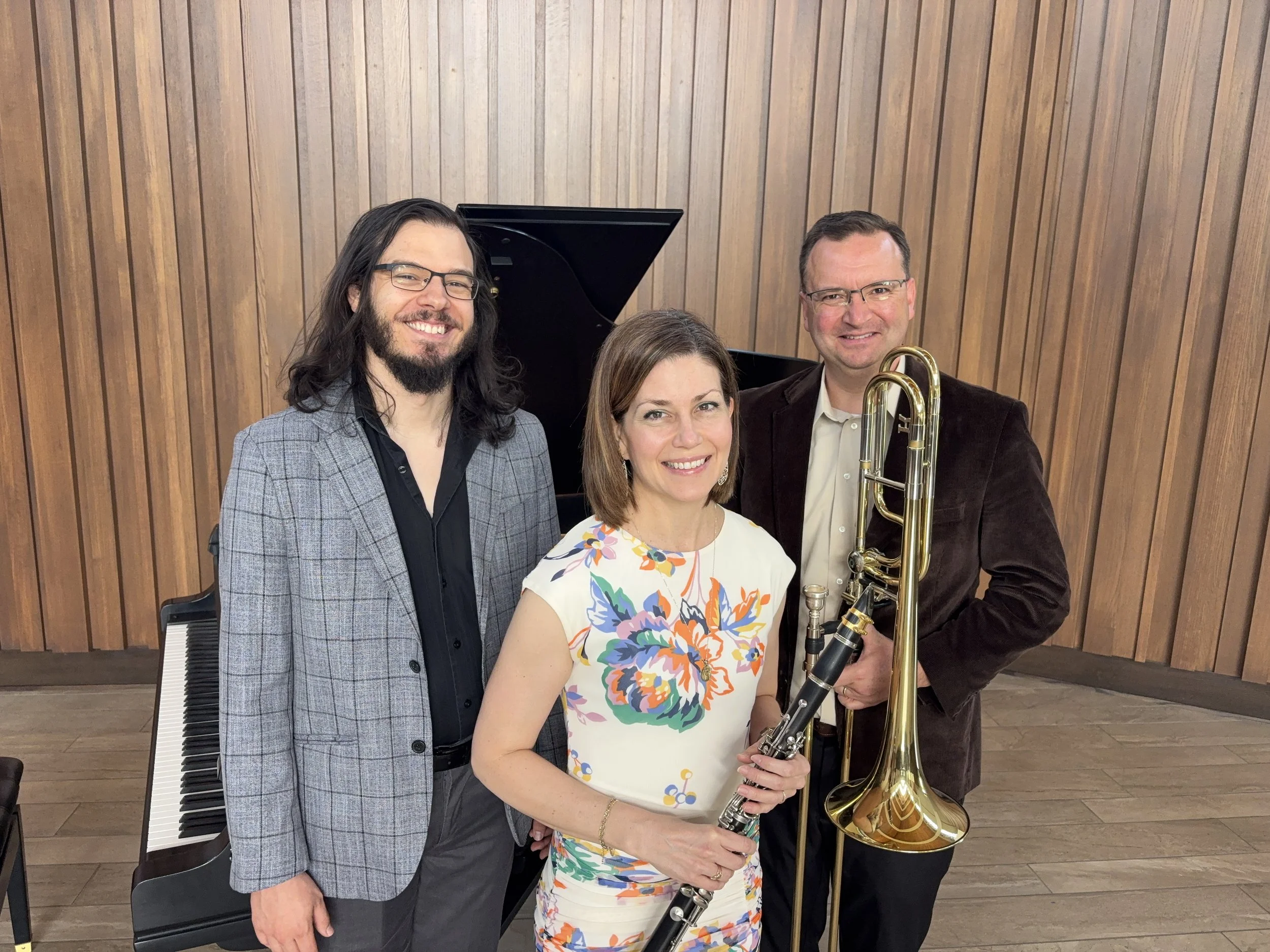
Welcome to Lighthearted Classics — an afternoon of music that smiles. Every piece on today's program was written by a composer who knew that great music and good fun were never enemies. From a Russian trombonist showing off for his friends, to Schubert dashing off an "improvisation," to an opera lover's greatest-hits parade, to young Beethoven borrowing the catchiest tune in Vienna — this is classical music at its most joyful, played by people who love it.
---
PROGRAM
1. Vladislav Blazhevich (1881–1942) — Concert Piece No. 5 (1938)
Rob Tierney, tenor trombone; KC Graham, piano
2. Franz Schubert (1797–1828) — Impromptu in E-flat major, Op. 90 No. 2, D. 899 (1827)
KC Graham, piano
3. Donato Lovreglio (1841–1907) — Fantasy on Themes from Verdi's La traviata, Op. 45 (1863)
Charisse Tierney, clarinet; KC Graham, piano
4. Ludwig van Beethoven (1770–1827) — Trio in B-flat major, Op. 11 "Gassenhauer" (1797)
I. Allegro con brio — II. Adagio — III. Tema con variazioni: Allegretto
Charisse Tierney, clarinet; Rob Tierney, trombone (cello part); KC Graham, piano
---
PROGRAM NOTES
Blazhevich: Concert Piece No. 5Vladislav Blazhevich was Russia's trombone man — principal trombone of the Bolshoi, professor at the Moscow Conservatory, and the composer who almost single-handedly built the trombone's solo repertoire, with thirteen concertos and etude books still in daily use a century later. Before the concertos came five Concert Pieces — "concert sketches," really — little showpieces he wrote for his students and colleagues. No. 5, composed in 1938, is the only one ever published, and it became the most-recorded Blazhevich work of all. It is Russian romanticism with a twinkle: long singing lines, nimble passagework, and a performer's sense of fun. Blazhevich wrote the way a man writes for friends — wanting everyone in the room to love his instrument as much as he did. That generosity of spirit is exactly what Lighthearted Classics is about.
Schubert: Impromptu in E-flat major, Op. 90 No. 2The impromptu was the nineteenth century's great musical improvisation — a piece that pretends to be made up on the spot. Schubert, writing in the summer of 1827 just over a year before his death at thirty-one, takes the idea and runs with it: the E-flat Impromptu bursts in with cascading triplets and no introduction at all, as if the music simply couldn't wait to begin. It is a moto perpetuo, perpetual motion — all sparkle and forward rush — until the middle section turns the mood on its head with a stomping dance (listen for the lilt of the Austrian Ländler). Then the sunlight returns, and the piece races home. Schubert at his most spontaneous reminds us that the profound can also be playful — that lightheartedness is not the absence of feeling, but feeling set free.
Lovreglio: Fantasy on Themes from Verdi's La traviata, Op. 45Before recordings, if you loved an opera you couldn't just stream it — you went to hear a virtuoso play its greatest hits live. Donato Lovreglio (1841–1907), an Italian flutist turned composer, made a career of exactly that: dazzling fantasies on the most beloved operas of the day, first performed across Europe to delighted crowds. His Traviata Fantasy, premiered in 1863, takes Verdi's most famous tunes — Violetta's music, the melodies all of Italy was humming — and spins them into a tour de force for clarinet: tender where Verdi is tender, breathtaking where the occasion demands fireworks, and faithful to the character of every aria it borrows. It was the nineteenth century's pop concert, and it still works the same magic today: great melodies, a great player, and an audience having the time of its life.
Beethoven: Trio in B-flat major, Op. 11 ("Gassenhauer")Beethoven's Fourth Piano Trio wears its nickname proudly: Gassenhauer — literally, a "street hit." The finale is a set of nine variations on "Pria ch'io l'impegno," a tune from Joseph Weigl's comic opera L'amor marinaro that was so catchy all of Vienna was whistling it in the lanes (Gassen). Beethoven, in his mid-twenties and the toast of Vienna, does what any great entertainer would do: he takes the town's favorite earworm and runs it through every mood he can think of — graceful, stormy, joking, tender. The opening Allegro con brio is all high spirits, and the Adagio sings like an opera aria. Possibly written on commission from a clarinetist, it is Beethoven at his most sociable — proof that genius and good fun were never enemies, and the perfect crown for an afternoon of Lighthearted Classics.
Bios
Rob Tierney
Rob Tierney is an accomplished and in demand professional trombonist and educator. Currently serving as trombone professor at Friends University he also holds the chair of Bass Trombonist with the Salina Symphony Orchestra. Other groups Mr. Tierney currently performs with in the Wichita area are the Wichita Grand Opera, Intrepid Brass Band and Intrepid Brass Quintet. Mr. Tierney holds a bachelor's of music education from the Crane School of Music, SUNY Potsdam and a master's degree in trombone performance from the New England Conservatory. He lives in west Wichita with his wife Charisse and their 7 children.
Charisse Tierney
Charisse Tierney lives in Wichita, Kansas, with her husband Rob and seven children. Charisse holds music degrees from Wichita State University and the New England Conservatory of Music in Boston. She has been teaching private music lessons for over 25 years. Charisse’s Music Studio offers lessons in piano and clarinet for all levels, as well as a weekly Montessori Piano class for children ages 3 to 6.
Charisse enjoys playing clarinet with various local professional ensembles, including the Wichita Symphony, Wichita Grand Opera Orchestra, Ballet Wichita Orchestra, and the Salina Symphony. An experienced principal, e-flat, bass, and section clarinetist, Charisse combines versatility with the highest level of musicianship. These qualities, developed through training at such places as NEC, Interlochen Arts Camp, Aspen Music Festival, Sarasota Chamber Music Festival, and Tanglewood Music Festival, are also evident in her performances of solo and chamber music repertoire.
KC Graham
KC Graham is an active pianist with a wide range of experience in both performing and teaching. He began to learn how to play the piano when he was seven years old. KC has won numerous competitions and scholarships including first prize in the Stephen Imbler Piano competition, first prize from the Arlington Arts League, and winner of both the Wichita State Concerto-Aria Competition and the UTA Concerto Competition. He has a wide range of performance experience including solo recitals, concerto soloist, chamber musician, orchestra pianist, accompanist, and even playing keyboard in a variety band.
In addition to being an active performer, KC is a passionate piano instructor. He own and operates Wichita Piano Studio. After 10+ years of teaching professionally, he has gained extensive experience teaching young children, adolescents, and retired adults, and is comfortable teaching beginning fundamentals through college level repertoire. As a late blooming pianist himself, KC is known for his patience and empathy for his students. His teaching received first place for the Wichita Metropolitan Music Teachers Association pedagogy award. KC’s teaching style is both motivating and practical, being adaptive to every student’s needs. He believes that music lessons are for everyone, and with inspiring instruction grounded in sound educational principles everyone can learn to enjoy their music lessons.